Get to know the building's architecture
No matter which direction you come from, you can't help but see the large dark tower building with bamboo on the roof as you approach Presteid.
At first glance, it looks almost surreal in the middle of the Nordland nature, but if you look closer, you might see how beautifully it sits in the landscape, as if it has always been there.
The location of the building is not accidental. On the left side by the footpath towards The Hamsun Centre you can see the ruins of the old rectory where Hamsun's uncle Hans worked. From the rectory ruins you can hear the roar of the ocean current Glimma. About where the center is located, stood the uncle's house where Knut spent some difficult years in his childhood. Up in the cemetery are Hamsun's parents buried.
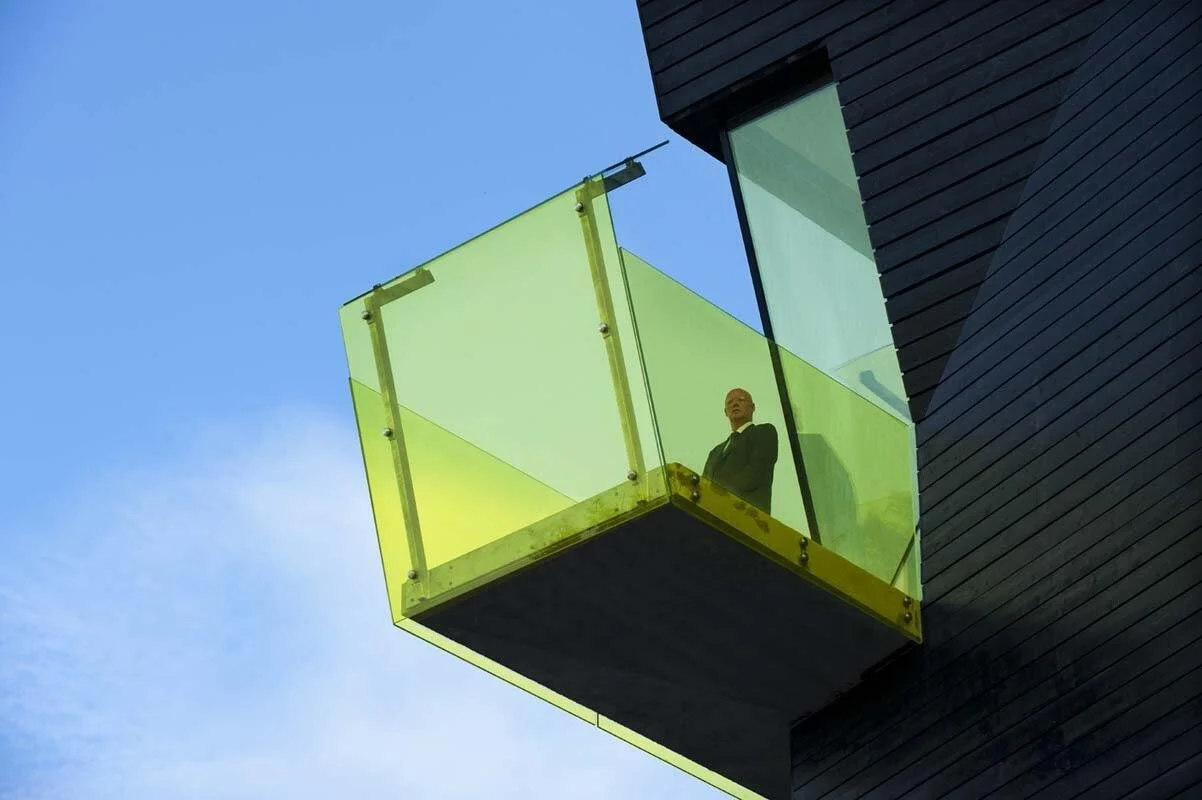
Right in front of you, you see the six-story tower building, darkly stained, crooked and crooked. It doesn't look much like a body or a face with its protruding balconies, windows and bamboo hair. Or maybe it gives you associations with an old house with grass on the roof? Seen from the other side, the building looks as if it is embracing itself. There is no doubt that you have arrived at a living building.
The interior of the building also gives the feeling of being a landscape. On the white painted concrete walls, wooden formwork has been used in the casting, so that the concrete has been imprinted with the wooden structure. No angles in the building are right, and although you can't always see it, you can feel it on your body that it is crooked and crooked.
The stairs wind their way up the building, inviting you to climb the tower like a mountain climber. The brass elevator stands like a spine in the middle of the building, ready to transport you between floors if you prefer. The balconies offer fresh air and a fantastic view of Hamsun's kingdom. The windows frame the landscape outside, transforming the sun's rays into columns of light that move with the seasons. The sun reflects in the brass elevator and forms different patterns on the walls and floors. The experience of The Hamsun Centre changes with the seasons, sun and light, making every walk in the tower a new adventure!
History of the building
After the war and the court settlement, Knut Hamsun was a national and cultural trauma in Norway for a long time. But on Hamarøy there were local enthusiasts who wanted to lift the memory of Hamsun and his connection to Hamarøy. Hamsun's 100th birthday was marked on Hamarøy on August 4, 1959, and two years later the author and resistance fighter Lars Berg unveiled a bust of Knut Hamsun in Hamsund.
Several of the film adaptations of Hamsun's books were eventually filmed on Hamarøy with local people as extras. The establishment of Hamsundagene in 1982 also contributed to increased focus on Hamsun. The idea of a centre for Knut Hamsun was actually first launched during Hamsundagene in 1985. It is by no means a coincidence that The Hamsun Centre is located on Hamarøy.
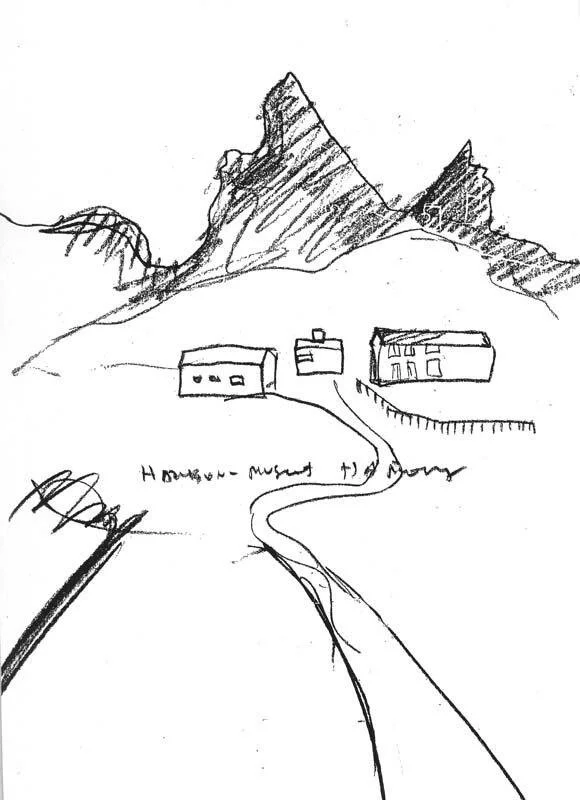
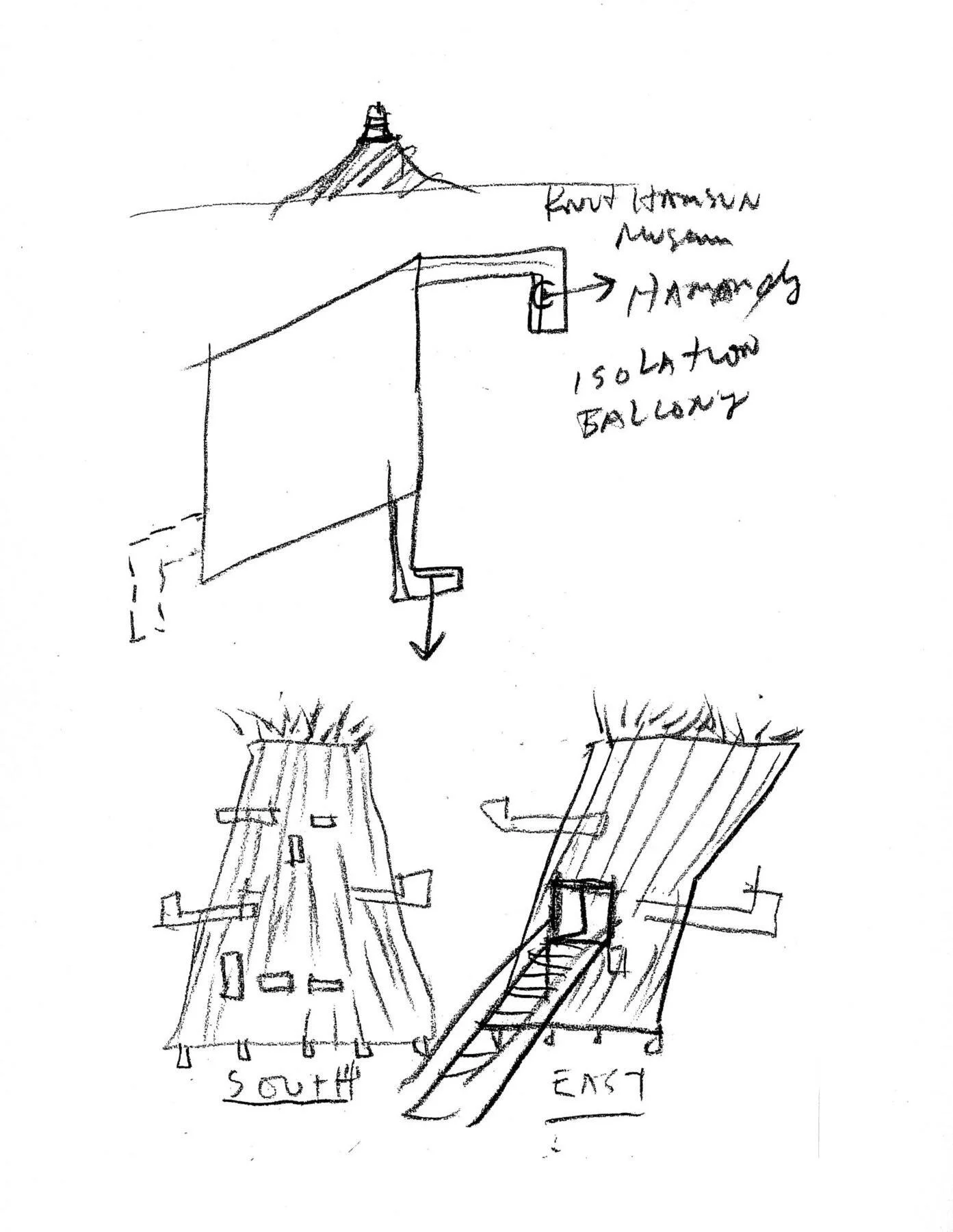
The American architect Steven Holl was commissioned to design a center for Knut Hamsun in the 1990s. In the fall of 1994, Steven Holl came to Hamarøy and within two days he drew the first sketches of the distinctive tower building. He immersed himself in Hamsun's writings and interpreted both Hamsun and his literature into the building.
In the early process, The Hamsun Centre intended to be placed at Knut Hamsun's Childhood Home in Hamsund. The location was reassessed and the building was added to Presteid, approximately where Hamsun's uncle Hans lived, by the old rectory ruins. In 1997 the architect presented a new sketch with two buildings, a cultural hall was added in addition to the tower building. The Hamsun Centre was completed for Hamsun's 150th birthday on August 4, 2009.
The Hamsun Center's characteristic tower building has, ever since the first sketches, sparked discussion and debate – and we are happy about that! The Hamsun Centre is a building that leaves a mark on visitors, it excites and provokes, is praised and criticized. That is precisely what makes The Hamsun Centre to one of Norway's most exciting buildings!
Architect Steven Holl
American architect Steven Holl was born in 1947 in Washington, but is of Norwegian descent.
In the 1970s, he established Steven Holl Architects. He is known for designing residential complexes in Fukuoka and Chiba, Japan (1991 and 1996) and the St. Ignatius Chapel in Seattle, USA (1997). Steven Holl had his breakthrough as an architect with Kiasma, the museum of contemporary art in Helsinki, Finland (1998).
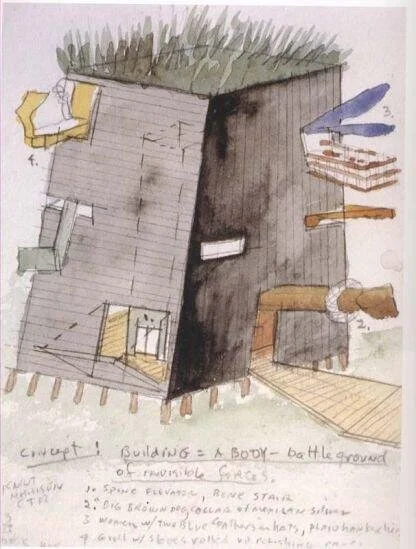
Steven Holl is not only known for his architecture, but also for his watercolors. Every new project starts with a watercolor sketch, which, according to the architect himself, is crucial for the further work.
Steven Holl has achieved great international recognition. In 2001, he was named the best American architect by Time Magazine because, among other things, he designs "buildings that satisfy the spirit as well as the eye". In recent years, he has also distinguished himself in Norway with the designs of The Hamsun Centre in Hamarøy. Work on the center began with watercolor drawings as early as 1994.
Before The Hamsun Centre Steven Holl has been awarded and nominated for numerous architectural prizes and awards. In 1997 he received the Progressive Architecture Award. For The Hamsun Centre Steven Holl has also been awarded the 2010 AIA NY Honor Awards, which are presented by the American Institute of Architects (AIA) New York Chapter. The Hamsun Centre was also nominated as one of the world's top five public buildings in the category Best New Public Building 2010 at the Wallpaper Design Awards by the international magazine Wallpaper, which is considered the leading journal in design and architecture. Steven Holl himself has described The Hamsun Centre as its most significant building.
The Hamsun Center's architecture has been nominated for a number of awards and distinctions, and has won a number of them. Most recently, the Houens Fonds Diploma 2012.
Awards and honors
Progressive Architecture Awards, USA, 1997
AIA NY Architecture Honor Award, USA, 2010
Northern Norwegian Architecture Prize, 2010
International Architecture Award, USA/Ireland, 2010
The Norwegian State Building Code Award, 2011
Houens Fonds Diploma 2012
Nominations
Wallpaper Design Awards, "Best new public building", London 2009
Condé Nast Traveler Innovation & Design Awards (I&DA), "Culture" 2010
Norway's ugliest building, NRK, 2010